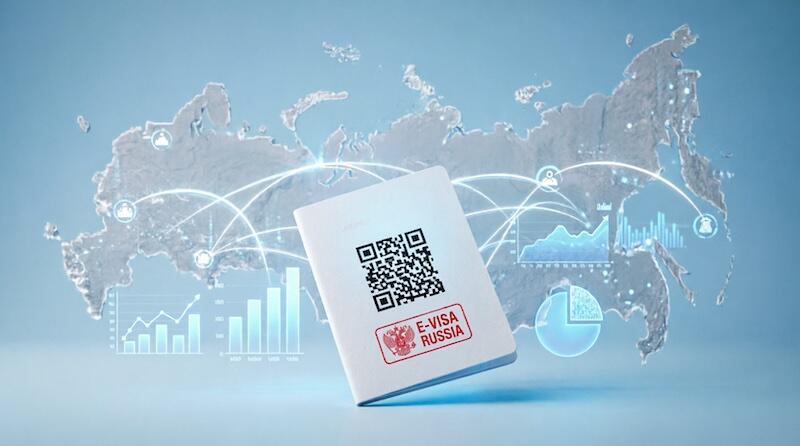
In 2025, Russia issued 821,262 unified electronic visas (here is the article how to obtain it), according to the Consular Department of the Foreign Ministry. These numbers are given in the article of ATOR (Association of Tour Operators of Russia). The total number of foreign trips to Russia reached 15.59 million, so e-visas accounted for about 5.3% of overall entries. However, this share is misleading because most trips come from CIS countries, whose citizens usually do not need e-visas. When excluding that flow, the proportion of e-visa holders rises to 19.2%. Tour operators view the electronic visa as a crucial driver for inbound tourism and believe that making it multiple-entry would significantly increase visitor numbers.
Chinese citizens topped the list of e-visa recipients in 2025, accounting for 325,619 visas—nearly 40% of all issuances. They were followed by Saudi Arabia (84,800), Germany (65,800), Turkey (60,100), India (55,500), Estonia (30,400), and Latvia (22,800). Together, these seven countries made up almost 79% of all e-visa issuances. However, the role of the e-visa is shifting across different markets. As Russia continues to expand visa-free agreements—notably with China, Saudi Arabia, and Oman—the share of tourists arriving specifically on an e-visa is gradually declining for some nationalities. Nevertheless, for markets without such bilateral deals, the e-visa remains an essential tool.
E-Visa is a Core Tool for India and Europe
According to Space Travel, the e-visa is currently the primary entry instrument for tourists from India and European countries, though the latter provide a relatively small volume. The company argues that the system has already proven its effectiveness and could logically be extended to remaining markets, such as the United States, Canada, and the UK, while continuing the policy of bilateral visa-waiver agreements with other nations.
For operators focused on markets where the e-visa is the main option, its uptake is nearly universal. At Intourist, around 95% of organized tourists from eligible countries choose the e-visa. The company attributes this to convenience: applications take little time, documents are submitted online, and applicants can track the status of their requests. Similarly, Tari Tour reports that 99% of its tourists from Southeast Asia, particularly Indonesia and Malaysia, enter Russia using the e-visa.
Payment Barrier
Tour operators report no major technical issues with the e-visa system. The application form is detailed but reliable, with no systemic failures or mass refusals.
A separate problem as payment barrier persists: some European countries prohibit their banks from processing consular fees for Russian e-visas. This creates an unnecessary obstacle, even though the system itself functions flawlessly.
The Market’s Top Wish: Multiple Entries
The duration of stay under the e-visa has already been increased to 30 days, but it remains a single-entry document. While this suffices for straightforward point-to-point itineraries, it limits combined travel programs. For instance, tourists wishing to visit both Russia and Belarus in one trip cannot re-enter Russia under the same e-visa, complicating such routes.